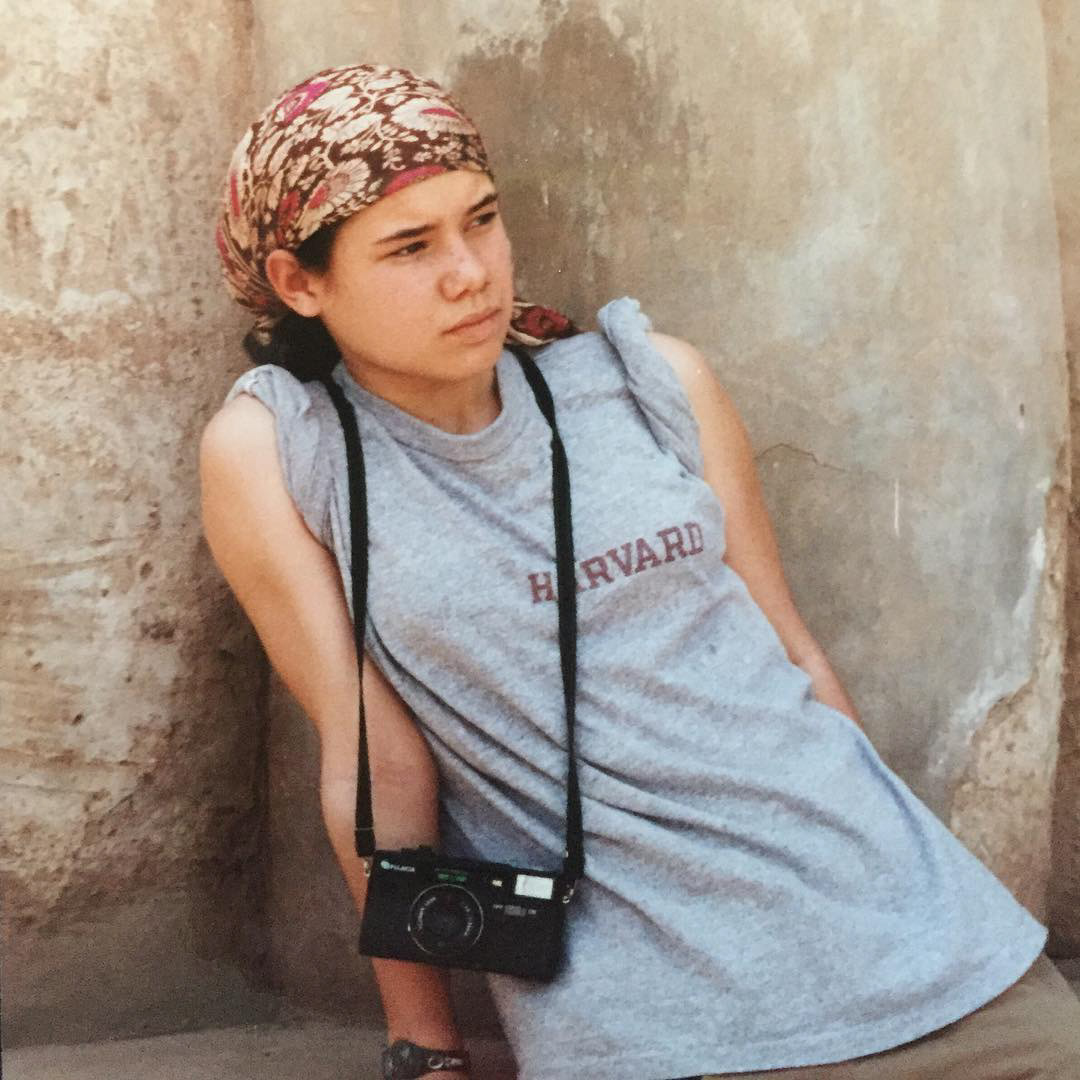
Director & Producer
Documentary Film- Work in Progress.
1887, Bordeaux, France: Edmond Dédé, a pioneering African American composer who escaped segregation in New Orleans to build a music legacy, completes a grand opera. 138 years later, it premieres, uncovering forgotten worlds. This investigative documentary takes us into a cross continental musical journey to restore his place in history.
PAST PRESENTATIONS :
Tuesday, March 24th, 2026 At The French Film Festival in New Orleans
Thursday, March 19, 2026 At The French Library in Boston
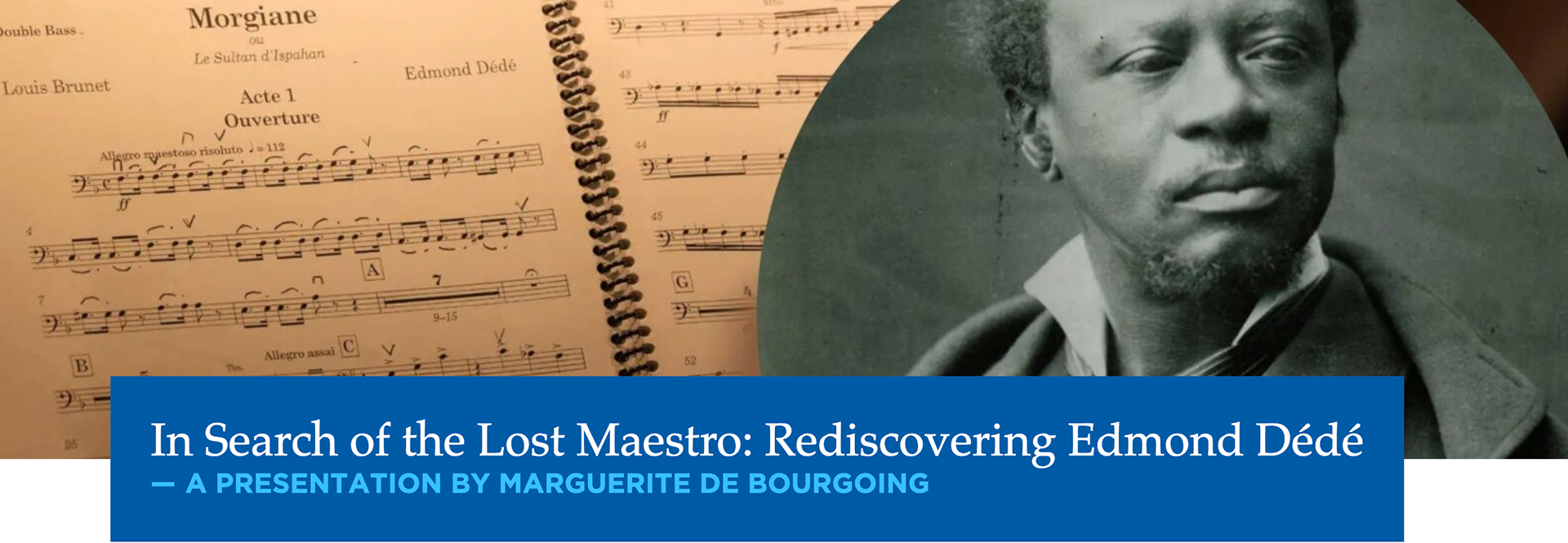
Did you know that for more than a century, one of America’s greatest operas was lost to history?
Born in New Orleans in 1827 as a free person of color, Edmond Dédé became one of the most accomplished classical musicians of the 19th century. Trained in the European tradition and deeply rooted in Creole culture, he built a remarkable career in France, where he conducted orchestras and composed nearly 150 works. Yet his greatest achievement, a four-act French grand opera titled Morgiane ou le Sultan d’Ispahan, was never performed during his lifetime.
More than a century later, Morgiane was rediscovered in the archives of Harvard University, where librarian Andrea Cawelti uncovered the handwritten score. This extraordinary find sparked a national effort to restore and bring Dédé’s long-forgotten masterpiece to the stage, led by DC based Opera Lafayette in partnership with Opera Créole in New Orleans.
In 2025, Morgiane finally premiered in New Orleans, followed by performances in Washington, D.C., and at Jazz at Lincoln Center in New York, marking a historic moment in American music history.
French filmmaker Marguerite de Bourgoing will present her ongoing documentary research on Edmond Dédé and the remarkable journey of Morgiane. She will be joined by Andrea Cawelti of Harvard University, who will share the story of the manuscript’s discovery.
The conversation will be moderated by Morgan Beckford, Director of Learning at Boston Lyric Opera, a soprano committed to broadening access to opera and celebrating diverse musical voices.
This event offers a rare opportunity to rediscover a forgotten master and celebrate a powerful chapter of transatlantic and African American musical history.
INTERVIEW IN THE SUD OUEST , from July 2025
This filmmaker resurrects Edmond Dédé, the forgotten Creole maestro
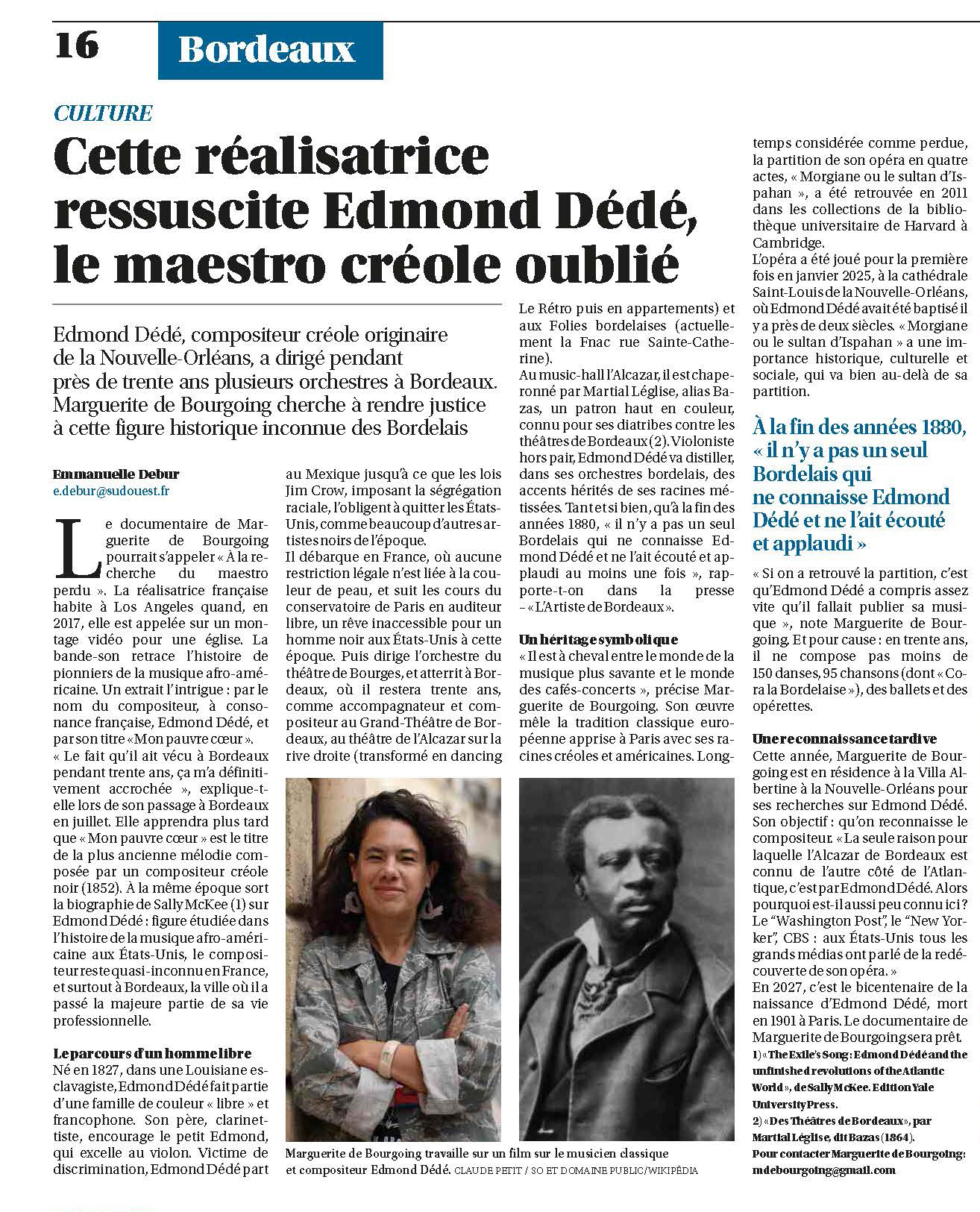
Marguerite de Bourgoing’s documentary could be called “In Search of the Lost Maestro.” The French filmmaker was living in Los Angeles in 2017 when she was hired to edit a video for a church. The soundtrack recounted the story of pioneers of African American music. One excerpt caught her attention: the name of the composer, with its French resonance, Edmond Dédé, and the title “Mon pauvre cœur.” “The fact that he lived in Bordeaux for thirty years definitely hooked me,” she explained during her visit to Bordeaux in July.
She would later learn that “Mon pauvre cœur” is the title of the earliest known melody composed by a Black Creole composer (1852). Around the same time, Sally McKee’s biography of Edmond Dédé was published: although studied as a significant figure in the history of African American music in the United States, the composer remains almost unknown in France, and especially in Bordeaux, the city where he spent most of his professional life.
Born in 1827 in slaveholding Louisiana, Edmond Dédé belonged to a French-speaking “free” family of color. His father, a clarinetist, encouraged young Edmond, who excelled on the violin. A victim of discrimination, Edmond Dédé went to Mexico for MUSIC until the Jim Crow laws, which enforced racial segregation, forced him to leave the United States, like many other Black artists of the time. He landed in France, where no legal restrictions were tied to skin color, and attended classes at the Paris Conservatory as an auditor — a dream that was out of reach for a Black man in the United States at that time. He then conducted the orchestra at the theater in Bourges, before settling in Bordeaux, where he would remain for thirty years, as accompanist and composer at the Grand Théâtre de Bordeaux, at the Alcazar theater on the right bank (later transformed into a dance hall and then apartments), and at the Folies Bordelaises (today the Fnac on rue Sainte-Catherine).
At the music-hall Alcazar, he was mentored by Martial Léglise, known as Bazas, a colorful impresario famous for his tirades against the theaters of Bordeaux. A virtuoso violinist, Edmond Dédé infused his Bordeaux orchestras with accents drawn from his mixed-race heritage. So much so that, by the late 1880s, “there was not a single Bordelais who did not know Edmond Dédé and had not listened to him and applauded him at least once,” reported L’Artiste de Bordeaux.
Long considered lost, the score of his four-act opera Morgiane ou le sultan d’Ispahan was rediscovered in 2011 in the collections of Harvard University Library in Cambridge. The opera was performed for the first time in January 2025, at St. Louis Cathedral in New Orleans, where Edmond Dédé had been baptized nearly two centuries earlier. Morgiane ou le sultan d’Ispahan carries historical, cultural, and social significance that goes far beyond its score.
“He straddles both the world of high art music and the world of café-concerts,” explains Marguerite de Bourgoing. His work blends the European classical tradition he learned in Paris with his Creole and American roots. Long considered lost, the score of his four-act opera Morgiane ou le sultan d’Ispahan was rediscovered in 2011 in the collections of Harvard University Library in Cambridge. The opera was performed for the first time in January 2025, at St. Louis Cathedral in New Orleans, where Edmond Dédé had been baptized nearly two centuries earlier. Morgiane ou le sultan d’Ispahan carries historical, cultural, and social significance that goes far beyond its score.
“If the score was rediscovered, it’s because Edmond Dédé quickly understood the importance of publishing his music,” notes Marguerite de Bourgoing. And with good reason: in thirty years, he composed no fewer than 150 dances, 95 songs (including “Cora la Bordelaise”), ballets, and operettas.A belated recognition
This year, Marguerite de Bourgoing is in residence at the Villa Albertine in New Orleans for her research on Edmond Dédé. Her goal: to bring recognition to the composer. “The only reason the Alcazar of Bordeaux is known on the other side of the Atlantic is because of Edmond Dédé. So why is he so little known here? The Washington Post, The New Yorker, CBS — in the United States, all the major media have covered the rediscovery of his opera.”
In 2027, it will be the bicentennial of Edmond Dédé’s birth; he died in 1901 in Paris. Marguerite de Bourgoing’s documentary will be ready by then.
Produced during the 2025 Villa Albertine residency in New Orleans for the March 2025 showcase at the Jazz Museum.
Dir: Marguerite de Bourgoing
Voice over: Melissa Laveaux
Additional cinematography: Zac Manuel, Oren Paley
Photography: Camille Farrah Lenain
Archive: Amistad Research Center
Featuring: Patrick Quigley, Mary Elizabeth Williams, Sultana Isham, & Givonna Joseph
The Music of Edmond Dédé: A free-born Creole of color from New Orleans, 2025
Cathedral footage Director of Photography
The Historic New Orleans Collection has collaborated with The Louisiana Philharmonic Orchestra for a classical concert series for 17 years. For this special concert, OperaCréole brought something unique and special by spearheading a project with the unique purpose of giving a long-deceased brilliant composer his flowers; they brought a piece of music from Edmond Dédé to be heard by the world once again.